


Do you have lots of questions about taking care of your newborn? Maybe you are expecting your first baby, or perhaps you already have children but those newborn days and weeks seem like a dim and distant memory!
How many nappies will I need? When should bath time be? How often will my baby need feeding? Hopefully this article will answer these questions and others you may have about taking care of your newborn.
Feeding Your Newborn
Feeding your little one is probably the most important part of taking care of your newborn.
Your new baby has a tiny tummy so they will eat little and often. It’s recommended that all babies are fed responsively, that means looking out for baby’s hunger signals and letting them decide when the feed is over rather than feeding by the clock. Think about your own eating habits: sometimes you need a big roast dinner, sometimes a salad or sandwich is all that’s needed to fill you up, and sometimes it’s just a drink you want. Your baby is the same, at some feeds they will be very hungry and at others less so. As long as they are producing enough wet and dirty nappies then try not to worry too much about schedules, minutes and mls.
If you are using formula, either exclusively or in combination with breastfeeding, make sure it’s first milk you are using. First milks are safe, complete foods for your baby, follow-on milks are not suitable under six months.
We have more detailed information in our formula feeding and breastfeeding blogs and in our breastfeeding videos here and here.
When it’s time to feed your little one find somewhere comfortable to sit. Hold your baby close and support their head during the feed. Make eye contact during the feed and monitor your little one for signs they are getting full.
Winding
Your baby will need winding to prevent air getting trapped by the milk in their digestive system and causing pain. You might want to pause the feed a few times for winding or you might prefer waiting until the end.
Try holding baby up against your shoulder – put a bib/muslin under them to catch any milk that comes up. You could also sit baby on your knee, making sure to support their upper body and head. Gently rub and pat your little one’s back to encourage the air bubbles to work their way out. Try not to be too vigorous though as they may bring up more than just wind!
Changing Your Newborn
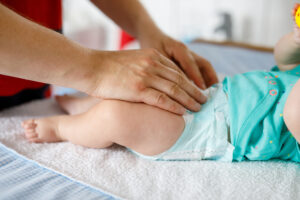
Image: Irina Schmidt
In the early days your new baby will only produce a few wet and/or dirty nappies. By the end of the first week though you should be changing at least six nappies a day, and 8 – 10 is not unusual. That adds up to a lot of nappies and a lot of changes in the first few months of taking care of your newborn.
You may have a changing unit in your baby’s room, you might prefer to change on the living room floor. If you are changing on a raised surface don’t leave your baby unattended.
Supplies
Having everything close at hand makes changing your little one much easier, you will likely need:
- Newborn nappies – between 45 and 70 disposables a week depending on your baby or ~24 reusable nappies.
- Cotton wool and warm water – baby wipes are handy but they aren’t recommended for newborns. Alternatively you could use washable wipes and water.
- A changing mat or towel to put under baby.
You may also want:
- Nappy bags – for the dirty nappy and cotton wool. If you are using reusable nappies have a wet bag or bucket handy.
- Barrier/nappy cream – this is not necessary at every nappy chance but if your baby has a bit of nappy rash some nappy free time and a thin layer of nappy cream will help their little bottom feel less sore.
Changing a nappy
Change your little one’s nappy as soon as possible after they wet or dirty it. It’s common for babies to fill a nappy during or just after a feed.
- Get all your supplies together and pop baby down on the changing mat.
- Open up the clean nappy so it’s ready to use.
- Take off socks and shoes, and move any clothes up around your baby’s upper body and out of the way.
- Undo the dirty nappy. Don’t whip it off straightaway – sometimes the cold air can stimulate a wee! Keep the nappy loosely in place for a few seconds just in case.
- Use the nappy to remove any heavy soiling. Now remove the dirty nappy, roll it up and close it up with the tabs then pop it in a nappy bag or wet bag.
- Gently wipe your little ones bottom and genital area with cotton wool or reusable wipes and warm water. Wipe from front to back to prevent spreading bacteria and make sure to clean between skin folds.
- Gently pat dry with cotton wool or a dry reusable wipe. Apply nappy cream if needed.
- Hold baby by the ankles an carefully raise their bottom off the mat so you can slide the clean nappy under them.
- Bring the front of the nappy up between your little ones legs and fasten the tabs. Check it’s not too loose or too tight – you should be able to fit two fingers inside the waist. If it’s too tight it will be uncomfortable for your little one, and if it’s too loose it will leak.
- Re-dress your baby and pop them somewhere safe while you dispose of the nappy and wash your hands.
Newborn Personal Hygiene
It will be some years before your baby is hogging the bathroom or there’s a cloud of Lynx (other deodorants are available!) following them around, until then taking care of your newborn’s personal hygiene is a job for the grown ups!
Bathing
Your little one won’t get very dirty and so daily bathing is not necessary. They will, however need freshening up from time to time.

Image: narong
As with changing, get all of your supplies ready before you start so they are close at hand. Your baby’s skin is very delicate, all you need to clean them for the first month or so is a cloth or cotton wool and warm water. Mix bath water well to avoid hotspots and test the temperature with your elbow – the water shouldn’t feel hot or cold. Alternatively you can use a thermometer, ideal temperature is around 37-38 degrees.
Use a small baby bath rather than trying to bathe your baby in the family bath. You can put the baby bath inside your big bath or pop it on the floor in the living room or bedroom. Where ever you choose to bathe your little one make sure it’s warm – a wet baby will quickly become cold.
Try not to bathe your baby when they are tired or hungry, it will be stressful for everyone!
If bathing your baby sounds a little daunting at first you might prefer to ‘top and tail’ instead. Rather than putting your little one in a bath full of water you use two bowls of warm water to clean your baby, one bowl for their upper body (top) and one for their bottom (tail). Whichever way you chose to bathe your little one the procedure is the same:
Never leave your baby unattended in the bath for any length of time
- Gather supplies – washcloths/cotton wool, a towel, clean nappy and nappy bag for dirty nappy, change of clothes or sleepsuit.
- Run water and check temperature then bring baby to the bath.
- Undress your little one to their nappy and vest.
- Wet some cotton wool or a flannel and clean your baby’s eyes. Clean from the inner eye (nose) to the outer eye (temple) and use a clean cloth for each eye.
- Using another clean cloth or cotton wool clean around your little ones ears. Don’t put anything inside your baby’s ears just clean what you can see.
- Clean the rest of your little ones face and head and gently dry their hair.
- Now you can fully undress baby and gently lower them into the water if you are using a bath.
- Clean around your little ones neck, their hands and feet. If they are in the bath you can gently splash water over their lower body.
- If you are topping and tailing remove the rest of your baby’s clothes.
- Using a clean cloth/cotton wool thoroughly but gently clean your baby’s genital area and bottom.
- Wrap your baby up in a warm fluffy towel, dry them off and put a clean nappy and clothing on.
Bathing can be a lovely bonding experience for both parents to be involved in. It can be a relaxing part of bedtime for some babies, though for others it’s too stimulating and a daytime bath is better. Your baby may not enjoy getting a wash at first but keep talking to and reassuring them, they will soon start to enjoy bath time.
Fingernails
Your baby’s fingernails will seem to grow very quickly and they can be sharp. You can get baby nail scissors or clippers to make trimming them a little easier. Alternatively you can gently file them with an emery board.
You may find it easier to trim your little ones nails while they are asleep!
Umbilical Cord
You can expect your baby’s umbilical cord stump to fall off at around a week to two weeks old. The stump will fall off by itself, don’t pull or fiddle with it. You don’t really need to do anything with it, just keep it clean and dry. Many newborn size nappies have a cutout to make room for the cord, if yours don’t you can just fold the front down a little so it’s out of the way.
If you notice any discharge or bleeding, if the skin around it becomes inflamed or it gets smelly then speak to your midwife or GP for advice.
Playing With Your Newborn
Babies and children learn through play and experiencing the world around them, this means play is an important part of taking care of your newborn. Your new baby will spend much of the day sleeping and feeding, but for short periods they will be awake and alert. During this time there are a number of ways you can interact and play with your little one.

Image: Syda Productions
- You could try some massage
- Sing – you could go for traditional nursery rhymes or belt out your favourite chart toppers!
- Imitate their facial expressions and the noises they make
- Read – you’re never to young to enjoy a book.
While the prospect of being responsible for a whole new life can feel daunting you’ll soon get the hang of it. As your baby grows you will also grow as a parent and soon you’ll be mumming or dadding like an old hand!
If you want tips from other parents around taking care of your newborn then why not pop over to our forum and ask the community?